Macro & Quantitative Research
Ground your gold trading in verifiable macroeconomic mechanics. Our research investigates the quantitative elasticity between spot gold (XAUUSD) and US 10-Year TIPS Real Yields, currency debasement velocity, central bank reserve diversification, and volatility regime transitions.
Featured Research Monograph

Macroeconomic Drivers of Gold: Real Yields, DXY & Central Bank Reserves
An econometric examination of spot gold valuation models, exploring the opportunity cost mechanism of US 10-Year TIPS Real Yields, currency debasement, and central bank reserve diversification.
Empirical Research Studies

Gold and the US Dollar Index (DXY): Statistical Correlation & SMT Divergence
A quantitative econometric study of the inverse relationship between the US Dollar Index (DXY) and spot gold (XAUUSD), detailing correlation mechanics, historical decoupling regimes, and SMT divergence trading models.

Gold and US Real Yields: Why 10-Year TIPS Are Gold’s Primary Anchor
An econometric research paper analyzing the relationship between US Treasury Inflation-Protected Securities (TIPS) real yields and spot gold valuations, detailing the Fisher equation, regression parameters, and the post-2022 sovereign regime shift.
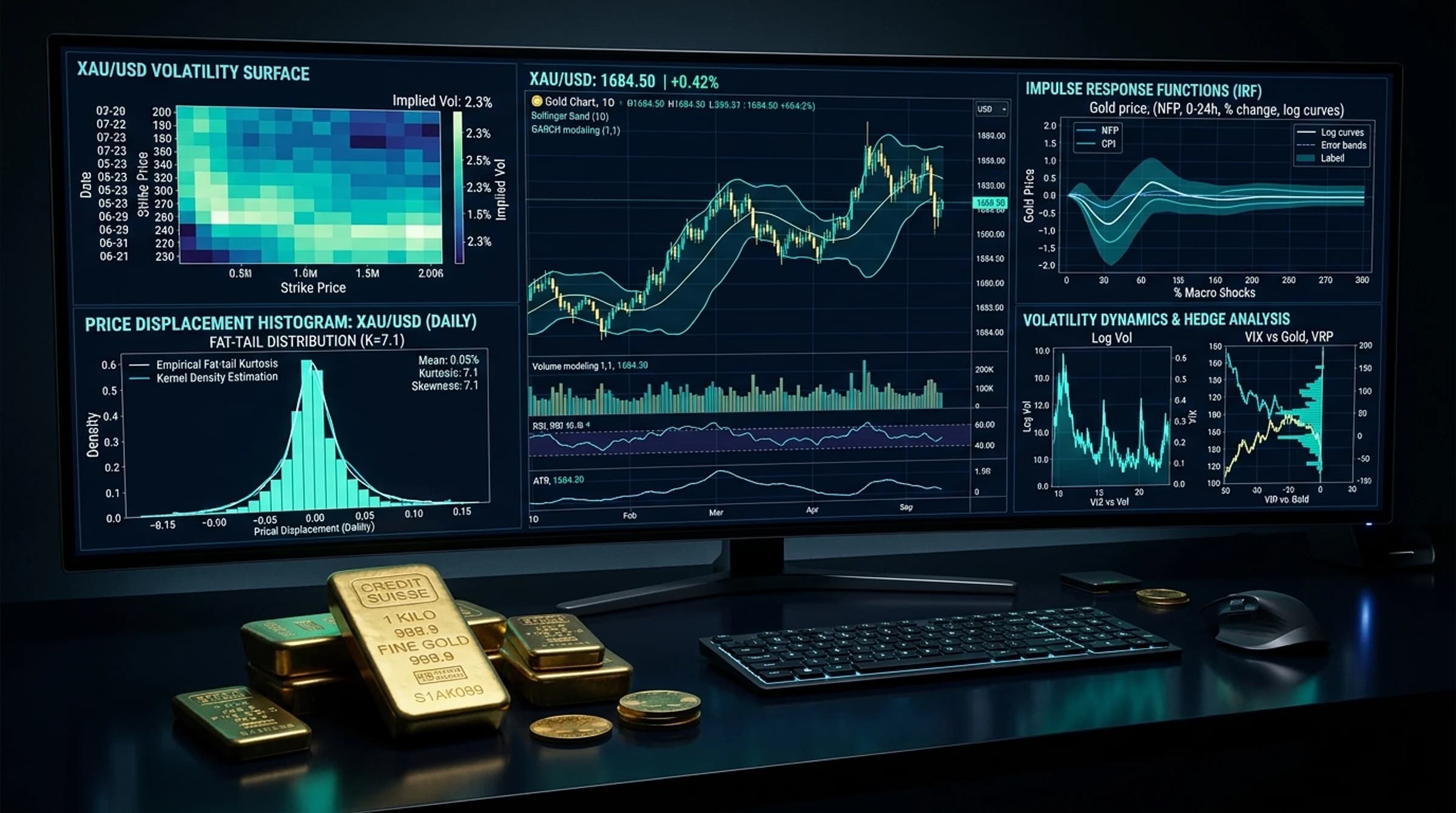
CPI & Non-Farm Payrolls (NFP) Impact on Gold: Volatility Playbook
A tactical and quantitative analysis of intraday volatility on spot gold during Tier-1 US macroeconomic releases (CPI and NFP), detailing order book liquidity withdrawal, whipsaw mechanics, and institutional post-news execution models.
All quantitative analyses published by the GoldTrading.AI Research Team adhere to reproducible econometric principles. We cite explicit historical sample periods, define regression transformations, and source telemetry directly from sovereign and exchange institutions:
Frequently Asked Questions About Gold Research
Q1:What datasets are used to build GoldTrading.AI econometric models?
Our quantitative research models ingest official sovereign and exchange datasets: the Federal Reserve Bank of St. Louis (FRED DFII10 10-Year TIPS and T10YIE Breakeven Inflation), CME Group COMEX Gold Futures (GC) commitment data, the London Bullion Market Association (LBMA) clearing statistics, and the Shanghai Gold Exchange (SGE) physical delivery premium series.
Q2:Why did the historical correlation between 10-Year real yields and gold decouple after 2022?
Following the 2022 G7 freezing of Russian sovereign FX reserves, global non-Western central banks (PBoC, RBI, CBR, NBP) recognized that foreign sovereign debt carries confiscation risk. Central banks initiated record price-inelastic physical bullion purchases (> 1,000 metric tons annually) that completely absorbed Western ETF liquidation and overwhelmed the mathematical drag of high US real interest rates.
Q3:How does GoldTrading.AI measure central bank gold purchases in real time?
Official central bank reserve updates are reported to the IMF International Financial Statistics (IFS) on a one-month lag. To capture unallocated and non-reporting sovereign flows in real time, our models track physical vault export flows from London/Zurich to China/India and analyze Shanghai Gold Exchange premium expansion above Loco London spot.
Q4:Can macroeconomic quantitative models be used for intraday trading?
Yes. Quantitative macroeconomic models establish directional bias (Bullish, Bearish, or Neutral) and identify structural price floors. Intraday execution desks use this macro filter to prioritize high-confluence technical setups (such as London Judas Swings aligned with falling real yields) while ignoring counter-trend technical noise.